Dinosaurs / Iguanodonts
Eolambia
Dinosaur Late Cretaceous
Eolambia was an iguanodont that lived in the Late Cretaceous, 100 to 94 million years ago.
- Lived
- 100 to 94 million years ago
- Fossil finds
- 12

Life restoration
What Eolambia may have looked like
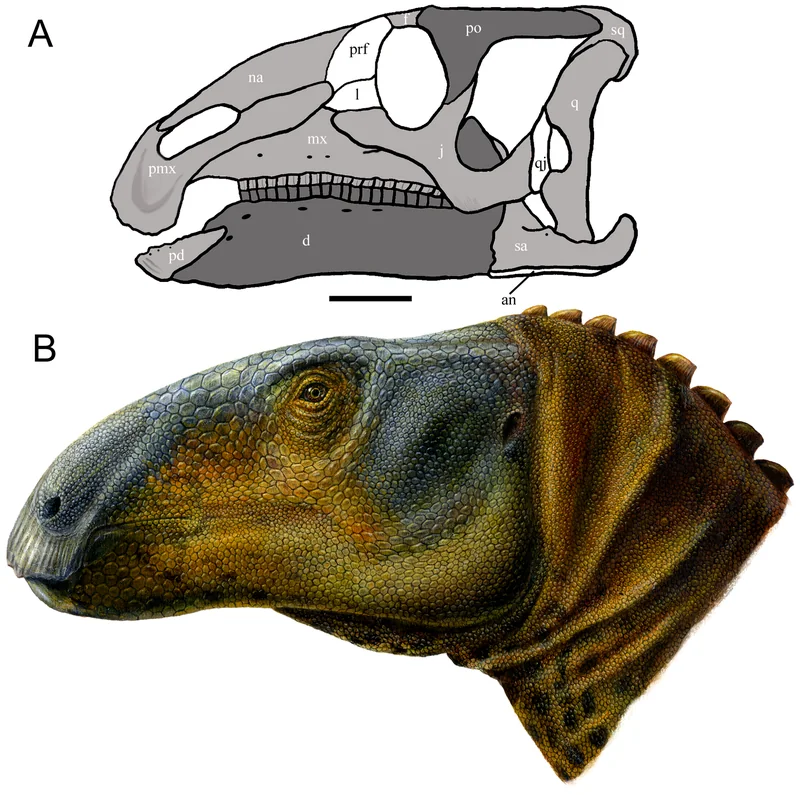
An artist's restoration from the fossils. Colour, skin and other soft parts are informed guesses. Eolambia by Lukas Panzarin and Andrew T. McDonald, Wikimedia Commons, CC BY 2.5.
Name
Name and family
The genus was named by Kirkland in 1998.
Its one listed species is Eolambia caroljonesa.
It is classed as a herbivore, a diet the database records for Ornithopoda as a whole.
It is one of 116 iguanodonts in the Paleobiology Database.
Family tree
- Iguanodontia
- Euiguanodontia
- Dryomorpha
- Ankylopollexia
- Styracosterna
- Hadrosauriformes
- Hadrosauroidea
- Eolambia
Fossils
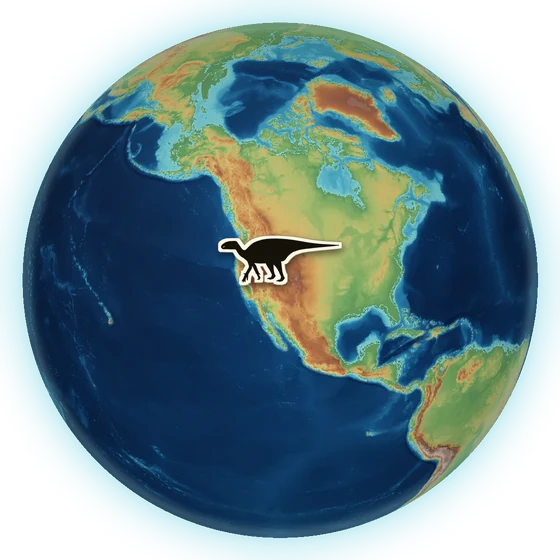
Where Eolambia has been found
12 fossil finds of Eolambia are recorded, in the United States.
In the United States it has been found in Utah.
All of the finds with a named rock unit come from the Cedar Mountain Formation.
On the atlas's maps its finds appear at 105 and 95 million years ago.
Rock formations Cedar Mountain Formation12
Neighbours
Its world
Its closest relatives in this atlas are Probactrosaurus, Claosaurus and Bactrosaurus.
Found in the same rocks
 StegosaurusStegosaurs
 TenontosaurusIguanodonts
 DeinonychusRaptors
- SauropeltaNodosaurs
 AcrocanthosaurusCarcharodontosaurs
- UtahraptorRaptors
- GastoniaNodosaurs
- CedarosaurusBrachiosaurs
Closest relatives
 Tanius
 Protohadros

Sources
Fossil records were read from the Paleobiology Database on 2026-11-16. Eolambia in the Paleobiology Database (CC0).
Ancient map: Scotese and Wright 2018, PALEOMAP PaleoDEMs, doi:10.5281/zenodo.5460860, CC BY 4.0, redrawn as shaded relief.
Life restoration: Eolambia by Lukas Panzarin and Andrew T. McDonald, Wikimedia Commons, CC BY 2.5.
Outline: Eolambia caroljonesa by Iain Reid, PhyloPic, CC BY 3.0.